


The Hidden Cost of AI-Generated Code
AI-generated code ships fast but hides security, performance, and ownership debt. See the risks and a 9-step pipeline to ship it safely.
Read article →html
Agentic AI
Sails Software · Enterprise Blog
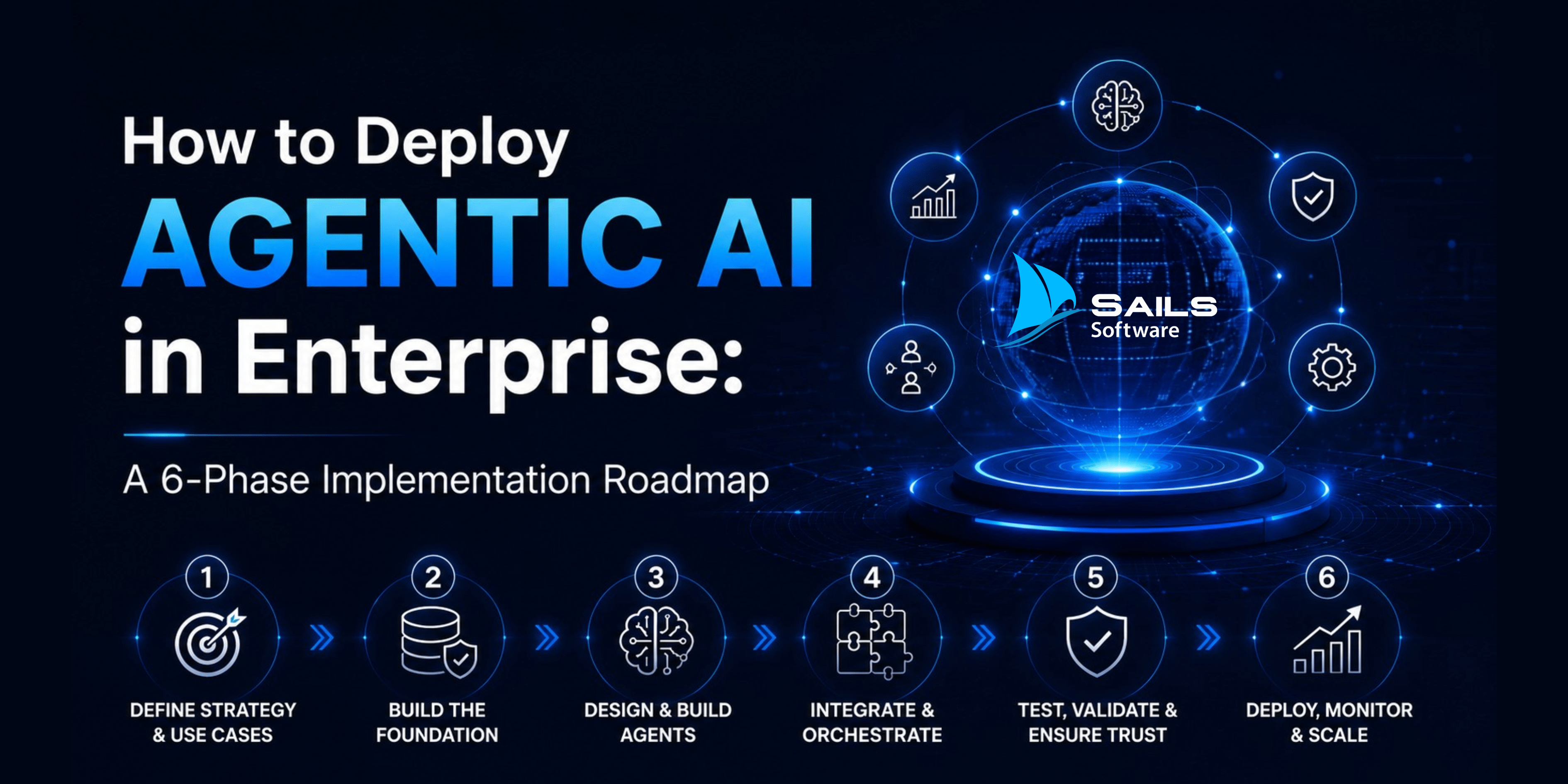
Deploying agentic AI in an enterprise environment is a six-phase process: use case identification, infrastructure assessment, agent architecture design, governance setup, phased rollout, and continuous monitoring. Most organizations that fail at agentic AI don’t fail at the AI — they fail at Phase 1 (selecting the wrong use case), Phase 2 (discovering data infrastructure gaps they could have identified in week two), or Phase 4 (treating governance as documentation rather than engineering). This roadmap is built from Sails Software’ enterprise implementations and covers what vendor pitch decks consistently leave out.
Agentic AI
Two questions need honest answers before you invest in scoping any phase. First: is this actually an agentic problem? Agentic AI produces its clearest ROI on high-volume, multi-step workflows where the bottleneck is human processing time. If the workflow runs fewer than 100 instances per month, the ROI math rarely closes within a 12-month horizon. If the workflow requires creative judgment that doesn’t follow a definable pattern, agentic AI will produce inconsistent results regardless of implementation quality.
Second: what is the actual state of your data infrastructure? This question gets the most consistent non-answer of any pre-implementation assessment. ‘Our data is in good shape’ is what enterprise technology teams say until an implementation reveals that a critical data source isn’t accessible via API, the document corpus hasn’t been updated in 14 months, three different systems use three different customer identifiers with no reconciliation layer, and the team responsible for one of the required integrations left the company six months ago. Phase 2 exists specifically to surface these gaps. Phase 1 should prime you to expect them.
Agentic AI
Duration: 2–3 weeks. The objective of Phase 1 is to identify not the use case with the highest theoretical ROI, but the use case with the highest probability of successful first deployment. First deployment credibility, in most enterprise organizations, is worth more than first deployment ROI. The second deployment is easier to fund, easier to staff, and easier to govern when the first one demonstrably worked.
Agentic AI
Duration: 3–4 weeks. This is the phase most organizations want to skip. It is also the phase whose outputs most directly determine whether the project finishes on time. Every week not spent here is typically three weeks of rework during integration testing.
The output of Phase 2 is a technical readiness report with a binary classification for each required component: ready (implementation can proceed with this component as-is) or requires remediation (specific work must be completed before this component can be integrated). Remediation items become the project’s critical path. Everything else is parallel work.
Agentic AI
Duration: 3–5 weeks. Phase 3 produces the technical blueprint. Every significant decision made in this phase has downstream consequences in performance, scalability, governance, and maintainability. The decisions that matter most:
Agentic AI
Duration: 2–3 weeks, concurrent with late Phase 3. This is the phase that separates agentic deployments that stay in production from those that get rolled back after the first incident. It is the most consistently underinvested phase and the one with the highest cost consequences when compressed or skipped.
Agentic AI
Duration: 4–6 weeks. Do not deploy directly to production autonomous mode. The three-stage rollout exists to surface integration issues, edge cases, and user experience problems in controlled conditions rather than production incidents.
The agent runs in parallel with the existing human workflow and produces recommendations for each workflow instance — but takes no actions. Human operators review agent recommendations alongside their normal process. Measurement focus: recommendation accuracy rate (what percentage of agent recommendations match what the human would have done?), false positive rate (how often does the agent recommend an action the human would not have taken?), and edge case catalog (what input types produce poor or unexpected recommendations?). The shadow mode output is a quality validation report, not a deployment checklist.
The agent takes actions in low-risk operational categories, with outputs routed to a staging environment and human approval required before promotion to production systems. This stage surfaces integration issues — unexpected API response formats, data quality failures, edge cases that Phase 2 assessment didn’t identify — in a recoverable context. Every failure in assisted mode is a prevented incident in autonomous mode.
The agent operates within its defined governance scope without human approval for each action. Human involvement is reserved for exception handling and instances that trigger HITL thresholds. Monitoring intensity should be highest in the first two weeks of autonomous operation. The threshold for reducing monitoring frequency: 500 or more successful production runs with error rate consistently below the defined acceptance threshold. Not a calendar-based milestone. A performance-based one.
User enablement is not a Phase 5 afterthought. The people working alongside the agent — reviewing exceptions, acting on escalations, evaluating output quality — require structured training on what the agent does, what constitutes a reportable error, and how to escalate concerns. A single onboarding session is insufficient. Plan for ongoing enablement that adapts as the agent’s capability scope evolves.
Agentic AI
Duration: Ongoing. The deployment is operationally complete when the monitoring infrastructure is running and the optimization cycle is established. Phase 6 determines whether the first deployment becomes the foundation for a scaled agentic capability or an isolated project that the organization points to as evidence that ‘AI doesn’t work here.’
Frequently Asked Questions
Phase 2 (infrastructure and data readiness assessment) and Phase 4 (governance and safety infrastructure) are jointly the most consequential. Phase 2 determines whether the project encounters preventable blocking issues during development. Phase 4 determines whether the production deployment stays live or gets rolled back after an incident. Both are systematically underinvested relative to their impact on outcomes. Organizations that invest these phases properly consistently outperform those that compress them on every downstream metric: time to production, production stability, and ROI realization.
Framework selection should follow three criteria: the complexity profile of the workflow (LangGraph for complex stateful workflows, AutoGen for conversational multi-agent patterns), your cloud infrastructure (AWS Bedrock Agents for AWS-native environments), and your security and audit requirements (custom orchestration on framework primitives for regulated environments with strict compliance requirements). For most enterprise first deployments, LangGraph or custom orchestration produces better long-term outcomes than higher-level frameworks because the explicit control flow aligns with enterprise governance requirements.
The most defensible ROI metrics are: staff hours saved per month (measured as the same workflow volume processed in less time, not estimated savings), error rate reduction for the specific task type (pre-deployment error rate vs. post-deployment agent error rate on identical task categories), and cycle time reduction (average time from workflow initiation to completion before and after). Convert hours to financial value using fully-loaded staff cost rates. Track monthly from Day 1 of autonomous mode, not from go-live announcement.
Work with Sails Software
Sails Software has implemented this six-phase methodology for enterprise clients in banking, pharmaceutical manufacturing, and HR technology. Whether you are starting Phase 1 and need help identifying the right use case, or stuck in Phase 2 and need an infrastructure assessment, our AI architects can accelerate your timeline and reduce your risk. Book a free deployment readiness assessment.
[email protected] · +1 248 750 6252 · sailssoftware.com

AI-generated code ships fast but hides security, performance, and ownership debt. See the risks and a 9-step pipeline to ship it safely.
Read article →
Next.js has become the default answer to a question that teams aren't always asking.
Read article →
Learn how spec-driven development helped our team avoid implementation drift, reduce rework, and ship more predictable engineering delivery.
Read article →Plan your project · Step 1 of 4
Our team will review your project and get back to you shortly.
Before you go…
Tell us what you're building — we'll help you plan the fastest path.